Export demand
Most U.S. cotton demand depends on exports.
Verified · USDA ERSAmerica grows world-class Pima cotton, exports most of it unspun, and buys the value back at a premium. The fiber is ours. The spinning value is not.
Explore the farms, gins, active mills, closed mills, ports, and routes that reveal America’s missing textile middle—and the proposed Yuma hub that can begin rebuilding it.
Interactive map · Select a site or route to explore the network.
Open the full map ↗The crisis isn't an accident of the market — it's the result of choices about what America chose to build, and what it let go.
America offloaded its spinning capacity — the mills, the machines, the know-how. We still grow the world's finest fiber, but can no longer turn most of it into quality yarn at scale.
For three decades the country poured capital into weapons and technology — but not the industrial backbone that turns cotton into value. So our farmers export almost all of their fiber, raw.
The price of American cotton is dictated by foreign buyers and overseas mills — not by the farmers who actually grow it.
Missing mills mean American cotton travels farther while spinning value and industrial capacity move overseas.
Most U.S. cotton demand depends on exports.
Verified · USDA ERSModeled spinning value captured abroad.
An illustrative offshore spinning route.
Illustrative routeAmerican cotton leaves as fiber and returns after the spinning value has been added overseas.
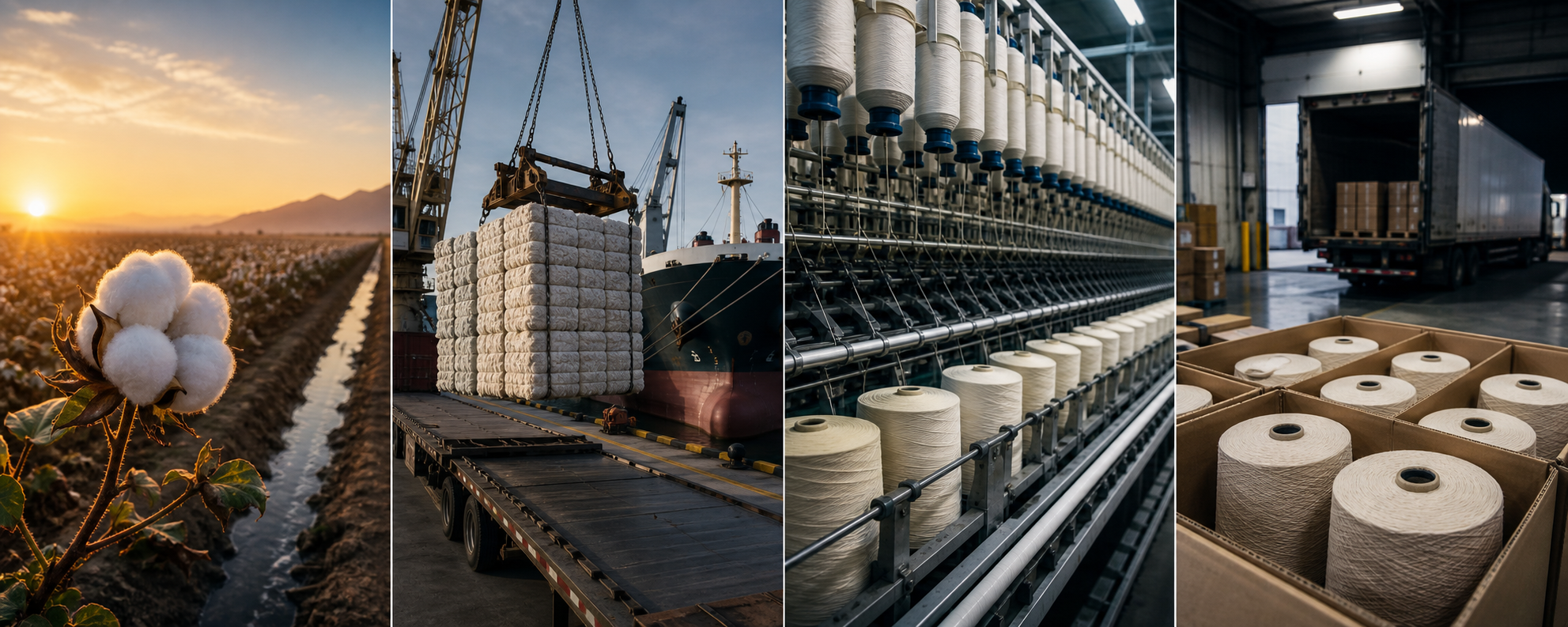
Premium cotton grown at home.
Fiber leaves as a raw commodity.
The highest-value step happens abroad.
Finished yarn returns with added cost and delay.
The raw fiber is always American. The question is where the spinning value-add is captured — and today the answer is: not here.
Every pound spun overseas exports $1.76 of value-add that a domestic ring-spinning hub would keep in American hands — multiplied across millions of pounds a year.
U.S. cotton farmers face unprecedented financial strain just as Yuma faces extreme structural unemployment. A farmer needs a buyer; a distressed region needs an industry.
Chapter 12 farm bankruptcies rose 46% across full-year 2025 (AFBF) — with first-half filings up even more sharply, ~57–70% over the prior year.
The suicide rate among agricultural workers runs roughly three times the national average.
Rise in farm input costs over five years — row crops unprofitable since at least 2022.
May 2026 preliminary, Yuma metropolitan area.
November 12, 2025; down 8.24% year over year.
Production surpassed consumption in 2024–25.
Five-year increase while major row crops remained under pressure.
Full-year 2025 Chapter 12 filings versus 2024.
Verified by USDA ERS for overall U.S. cotton demand.
Fifth-generation cotton and soybean farmers in Tennessee and Missouri describe the same forces behind this initiative: crops unprofitable since 2022, input costs up 30%+ in five years, a 57% rise in farm bankruptcies in the first half of 2025, and an agricultural suicide rate three times the national average.
Sources: documentary footage (YouTube, 2025) corroborating Yu-Pima Cotton Initiative proposal figures; farm bankruptcy data per American Farm Bureau Federation (full-year 2025); cotton futures per Trading Economics / USDA, Nov 2025.
A domestic ring-spinning hub in Yuma, Arizona closes the loop — and keeps the value on American soil.