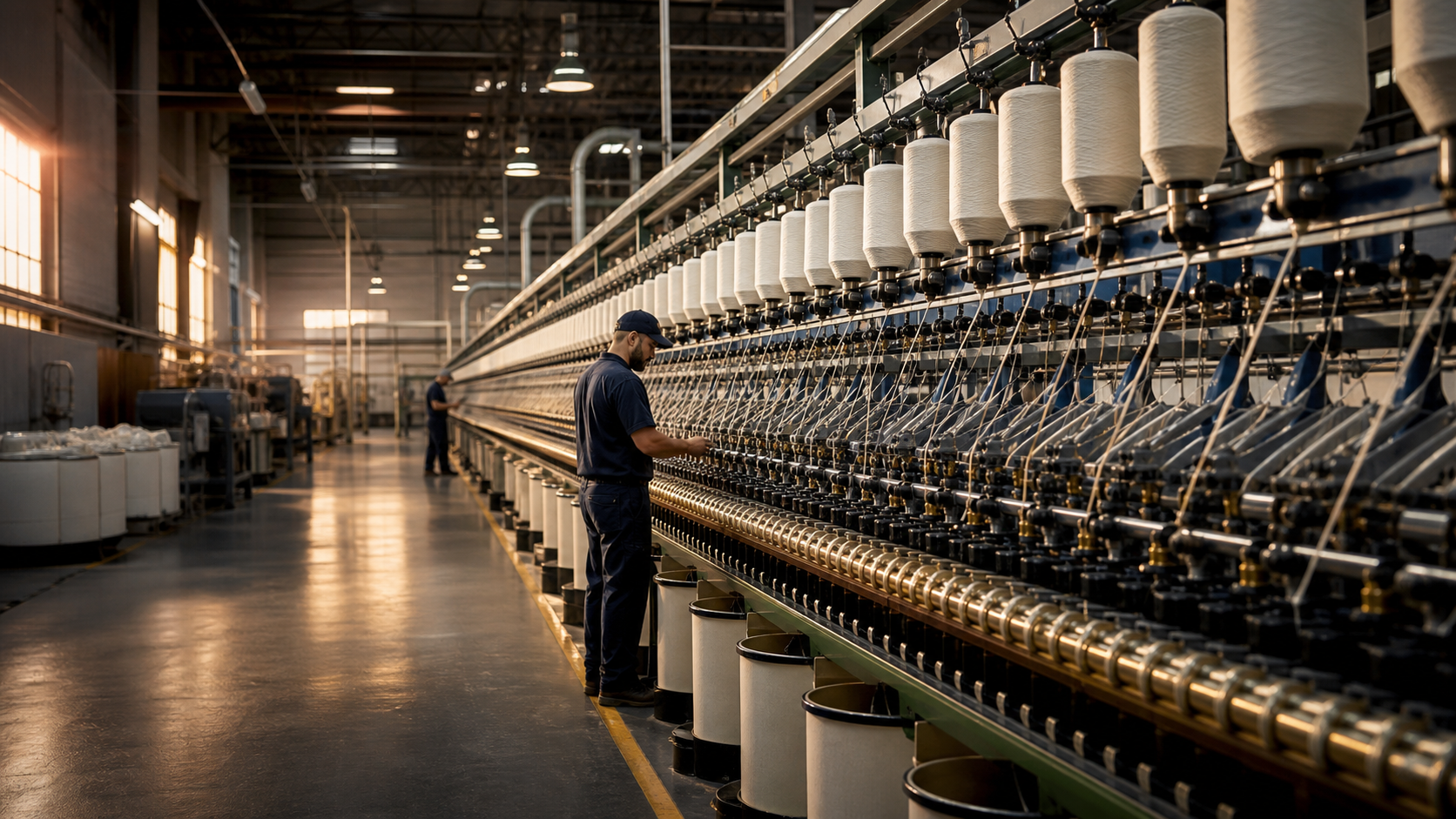
The Yu-Pima Cotton Initiative asks the EDA to fund the first ring-spun yarn facility in the western United States — not as a subsidy, but as the structural fix to two national problems at once: a collapsing U.S. cotton economy and one of America's most persistently distressed labor markets.
America grows the world's finest Pima cotton, then ships the fiber overseas to be spun into yarn — exporting the jobs and the value with it. The Yu-Pima Cotton Initiative closes that loop on American soil, in exactly the kind of distressed community the EDA exists to lift.
A stable, long-term domestic contract market for U.S. cotton growers — insulating them from the global price collapse driving record bankruptcies.
Re-shore premium ring-spun yarn capacity that doesn't exist anywhere in the western US, ending dependence on volatile imports and tariffs.
Bring non-seasonal, high-wage manufacturing jobs to Yuma County, a federally eligible distressed area with chronic structural unemployment.
U.S. cotton farmers face unprecedented financial strain just as Yuma faces extreme structural unemployment. Each crisis is the other's solution — a farmer needs a buyer; a distressed region needs an industry.
Chapter 12 farm bankruptcies rose 46% across full-year 2025 (AFBF) — with first-half filings up even more sharply, ~57–70% over the prior year.
The suicide rate among agricultural workers runs roughly three times the national average.
Rise in farm input costs over five years — row crops unprofitable since at least 2022.
August 2025 — with a labor-force participation rate near 52%, far below the U.S. average.
| Metric | Data point | Context |
|---|---|---|
| Cotton futures price | 63.14¢/lb (Nov 12, 2025) | Down 8.24% year-over-year; forecast to fall further to ~58.98¢/lb within 12 months. |
| Global supply glut | +392,000 tonnes | Production surpasses consumption for 2024–25, driving downward price pressure and inventory build-up. |
| Input cost increase | >30% over 5 years | Inflation, rising interest rates, and supply-chain disruption — major row crops unprofitable since 2022. |
| Farm bankruptcies | +46% (2025) | Chapter 12 filings, full-year 2025 vs. 2024 (American Farm Bureau Federation). First-half filings rose even faster — ~70% in Q1; CBS News reported +57% for the first six months. |
| Exported U.S. fiber | 87% | Most U.S. cotton fiber is exported because there is no domestic spinning capacity for premium yarn such as Supima. |
Fifth-generation cotton and soybean farmers in Tennessee and Missouri describe the same forces behind this initiative: crops unprofitable since 2022, input costs up 30%+ in five years, a 57% rise in farm bankruptcies in the first half of 2025, and an agricultural suicide rate three times the national average.
Sources: documentary footage (YouTube, 2025) corroborating Yu-Pima Cotton Initiative proposal figures; farm bankruptcy data per American Farm Bureau Federation (full-year 2025); cotton futures per Trading Economics / USDA, Nov 2025.
Yuma isn't a sentimental choice — it's the logistically and economically optimal one. It sits at the center of the cotton belt, on top of premium freight corridors, inside a Foreign Trade Zone, in a federally eligible distressed area.
Spinning is energy- and water-intensive. Arizona delivers both far cheaper than neighboring California — turning a regional choice into a durable competitive edge for domestic yarn.

Arizona power costs less than half of California's and sits below the 15.2¢ national average — a decisive advantage for an energy-intensive spinning operation. (Cents per kWh, Oct 2025.)

California ranks among the five most expensive states for water; Arizona's rates sit well below it — meaningful for a water-using process and another reason to spin in Yuma, not across the border.
Sources: Visual Capitalist / Electric Choice, electricity cost by state (Oct 2025); Water Prices by State 2025.
The Eco-Spun Yuma facility creates a closed loop of domestic value: the farmer gains a stable market, Yuma gains an industry, and U.S. textile producers gain a reliable, proximate, premium supply chain.
Premium fiber from AZ, CA & TX growers under long-term contracts — e.g. 5-year supply agreements.
Modern, automated ring-spinning produces premium yarn (Supima-grade 30/1) on American soil.
I-8 and Union Pacific carry yarn to California and Southeast textile hubs — faster than imports.
Brands gain a secure, ethical, tariff-insulated domestic source — reliable, fast, made in the USA.
Reference market price: imported Supima ring-spun 30/1 runs about $4.40–$4.60/lb in Los Angeles with tariff — the gap a domestic spinner can compete into.
The initiative captures value the United States currently exports. At today's market prices (June 2026), the spread between raw fiber and finished domestic yarn is the case for spinning at home.
| Product | Market price | Basis & notes |
|---|---|---|
| Raw cotton fiber | 67–72¢/lb | ICE No. 2 nearby futures / USDA 7-market spot average, June 2026. A 480‑lb bale ≈ $325–$345. |
| Commodity ring-spun yarn (30/1) | $1.65–$2.50/lb | Imported Asian/Indian combed cotton benchmark (~$3.60–$5.50/kg). |
| Premium Supima yarn (30/1) | $4.40–$4.60/lb | Imported Supima ring-spun, delivered Los Angeles, with tariff — the domestic target price. |
One 480‑lb bale of raw fiber (≈$345 today) spins into roughly 410–430 lb of premium ring-spun yarn — worth on the order of $1,850–$1,950 at current delivered-LA Supima prices. That conversion value is the difference between exporting American fiber and finishing it on American soil. Per-unit gross figures shown; net margins depend on energy, labor, and capital, which the Yuma cost advantages (electricity, water, FTZ #219) are designed to optimize.
Sources: ICE / USDA AMS cotton prices (June 2026); imported yarn benchmarks per Yu-Pima Cotton Initiative proposal and trade pricing. Figures are indicative market ranges, not quotations.
From feasibility to a fully staffed facility — each phase matched to the appropriate EDA program, sequenced to de-risk federal investment.
Feasibility & market studies and financial structures to de-risk the project before construction — including capitalizing a Revolving Loan Fund for the new textile industry in Yuma.
Construction of the Eco-Spun spinning facility via an EDA Public Works grant — including road, utility, and rail-spur connections to the I-8 / Union Pacific corridor — creating 200+ sustainable manufacturing jobs.
Recompete Pilot Program, Good Jobs Challenge, and STEM Talent Challenge — partnering with the University of Arizona–Yuma and Arizona Western College to train local workers for advanced, automated spinning and close the prime-age employment gap.
Figures are planning-stage estimates across multiple EDA program tracks and will be refined with EDA and regional partners during application.
A data-driven proposal that addresses two national economic imperatives at once — with outcomes the EDA can measure.
A stable, long-term, domestic contract market for U.S. cotton farmers — reducing reliance on volatile commodity futures.
Diversification into non-seasonal, high-wage manufacturing — a demonstrable cut in the 18.2% unemployment rate and a closing prime-age employment gap.
A faster, more secure, cost-efficient domestic yarn supply chain on the I-8 / Union Pacific corridor — insulated from tariffs and ocean-shipping volatility.
A regional coalition spanning education, agriculture, ginning, industry, and economic development — the local backing the EDA looks for.
Every figure on this page is sourced to public data or primary reporting. Key references below; full documentation available on request.
Note: utility-cost figures cited from the on-page charts reflect those publishers' methodology; U.S. EIA residential averages differ modestly but confirm the same Arizona-vs-California advantage. Funding figures are planning-stage estimates and not a commitment of federal funds.
We're building the coalition to bring premium yarn spinning back to the United States — saving farmers, creating jobs, and making "Made in America" real from field to finished shirt.
Get in Touch